

How a Ragdoll Kitten Experiences Your Home in the Morning
Before breakfast, play, or a warm lap, your home is already communicating with a Ragdoll kitten. Morning light changes the shape of familiar furniture. Doors open and close. Footsteps travel through the floor. A quiet room becomes busy in a few minutes.
For many Ragdolls, who often enjoy staying near their people, the important question is not simply whether a room is large. It is whether the kitten can see what is happening, reach the interesting parts of the home without awkward obstacles, and retreat without becoming completely isolated. Thinking about a Ragdoll kitten home environment from floor level can reveal details owners frequently overlook.
The morning begins with sightlines
A kitten may appear to be lingering in a doorway when it is actually studying several parts of the home at once. From the floor, a doorway can offer a view of your bedroom, the hallway, and the room where you are preparing to start the day. That position lets a Ragdoll remain socially connected without committing to one activity.
This is especially relevant to a breed often described as people-oriented, although individual Ragdolls vary considerably. Some kittens want to follow every movement. Others prefer to watch first and join later. Furniture that blocks every view can make a room feel more disconnected than its square footage suggests.
Try sitting on the floor in the main morning area for a minute. Notice whether a kitten resting there can see a person approaching, a doorway opening, or another part of the household. A low piece of furniture placed along a wall may be more useful than a bulky item in the middle of a passage because it creates a resting edge while preserving a clear view.
Doorways are more complicated than they look
Humans usually treat a doorway as a simple opening. A kitten experiences it as a change in light, temperature, sound, flooring, and movement. A polished floor leading to a thick rug may feel less predictable than two surfaces that look similar to us. A swinging door can suddenly remove a familiar route.
One overlooked observation is that a kitten who pauses at a threshold may not be afraid of the room beyond it. The hesitation may be about the transition itself. Watch what happens when the kitten crosses: does it step carefully over the surface, look back at the door, or wait for the floor to become still? These details can tell you more than the pause alone.
For a more comfortable layout:
- Keep rugs and runners firmly in place so the route does not shift under small paws.
- Avoid arranging furniture so a kitten must squeeze between a wall and a moving door.
- Leave a visible way out of busy rooms rather than creating narrow dead ends.
- Check that a favorite resting edge does not disappear whenever a household door is closed.
These changes are not about making every room empty. They are about making movement predictable.
Furniture has a different scale from the floor
A Ragdoll kitten can look tiny beside an adult sofa, but the breed’s eventual size is worth remembering when arranging a home. A gap that seems inviting during kittenhood may become difficult to turn around in later. Likewise, a low table with several legs may create a maze of partial hiding places, while a chair beside a wall may offer a simpler place to observe.
Many kittens choose the edge of human activity rather than the center of it. A Ragdoll may settle beside a kitchen island, under the end of a desk, or near the first chair used in the morning. The location provides companionship without the constant movement found in the middle of a walkway.
Look for places that combine three qualities: a clear view, enough room to change position, and an easy exit. This is one reason a quiet corner beside a frequently used chair can be more attractive than a secluded bed in a spare room. The best location is often not the softest one; it is the one that balances rest with awareness.
Morning movement can change the kitten’s route
A Ragdoll kitten may use one path when the house is quiet and another when everyone is awake. In the early morning, the shortest route to a person may be preferable. Later, when chairs have moved and appliances are running, the kitten may travel around the outside of the room instead.
Notice whether your kitten repeatedly appears at the same points in the home. It may be choosing locations that connect separate activities: the hall outside a bedroom, the corner between the kitchen and living room, or the end of a sofa facing the main passage. These are architectural meeting points. They allow the kitten to keep track of people without following them constantly.
A useful design lesson is to preserve at least one calm route through the areas you use most in the morning. Do not place every object against the walls simply for appearance if doing so makes the remaining walkway narrow. A kitten that can travel around activity rather than through it may be more willing to remain nearby.
Light, shadows, and changing room boundaries
Morning sunlight can transform a familiar room. A bright rectangle on the floor may become an appealing resting place, while a dark shadow beneath a chair may suddenly look like an inviting retreat. As the sun moves, a kitten may shift positions even though the room’s furniture has not changed.
Perspectives also change when human-sized objects move. A coat placed over a chair, a laundry basket left in the hall, or an open cupboard can create a temporary wall from kitten height. Rather than assuming a kitten is being inconsistent, observe which visual changes precede a change in location.
For prospective owners, this is a practical implication of living with a Ragdoll: you do not need a huge home, but connected areas with understandable boundaries can matter. A small apartment can work well when the kitten has a place to observe people, a stable path between commonly used areas, and a retreat that is not cut off from household life.
Persian and Ragdoll kittens in the same home layout
Persian and Ragdoll kittens can both appreciate calm, comfortable places near their people, but they may use architecture differently. Many Ragdolls are inclined to monitor household movement from an open edge of a room and may relocate to remain close to a person. Persians are often more content with a settled, sheltered position and may place greater value on a quiet nook away from passing feet. These are tendencies, not rules.
Body shape and coat can also influence practical choices. A growing Ragdoll may eventually need more turning space around furniture, while a Persian’s shorter facial structure and dense coat make a clean, low-traffic resting area especially appealing. With either breed, the kitten’s actual choices matter more than a breed stereotype. Watch whether your individual kitten seeks open sightlines, enclosure, or a balance of both before rearranging the room.
What to watch tomorrow morning
Instead of immediately moving furniture, observe the first few minutes of the day. Ask yourself:
- Does the kitten choose a place where it can see several doorways?
- Does it hesitate at a particular floor transition?
- Does it follow people directly, or relocate to the next room before they arrive?
- Does a newly moved object change the route or resting place?
- Does the kitten prefer the center of activity, its edge, or a nearby room with a clear view?
The answers can guide small, sensible changes without turning the home into a staged cat area. A stable runner, a clearer passage, or a resting spot beside—not inside—the busiest route may be enough.
Your Ragdoll kitten is not reading the home as a collection of rooms. It is experiencing surfaces, openings, sightlines, and the movement of the people it trusts. Once you notice those details, ordinary morning behavior becomes useful information about how your home feels from a much smaller point of view.
For more thoughtful guidance on living with Persian and Ragdoll kittens, explore CTkittens.com.

Rachel Cohen is a journalist and producer with a passion for audio storytelling, health and science reporting, and feline companions.
A graduate of Middlebury College, Rachel spends her weekends exploring the mountains and when she isn’t outdoors or chasing a story, she can usually be found hanging out with her cats.
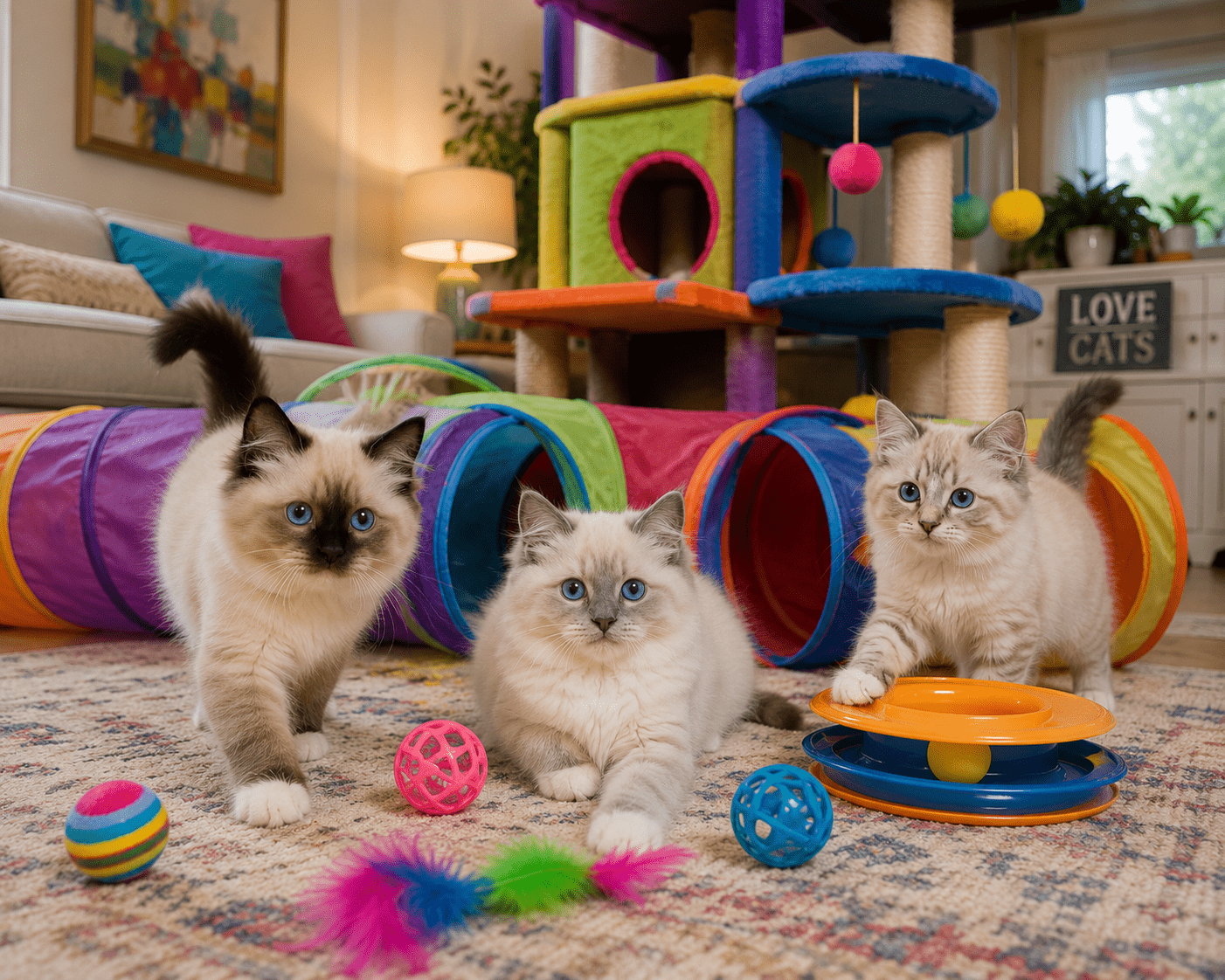

especially around those doorway thresholds where rugs, doors, and changing light can make a familiar route feel uncertain.
Watching the actual crossing seems like a much better clue than labeling the behavior too quickly.